 Tyne Seedling
You will learn to distinguish between overwatering, wind dehydration, and calcium lockout in small container soil. Pinpointing the root issue keeps your potted sweet and hot peppers setting crisp, full pods.
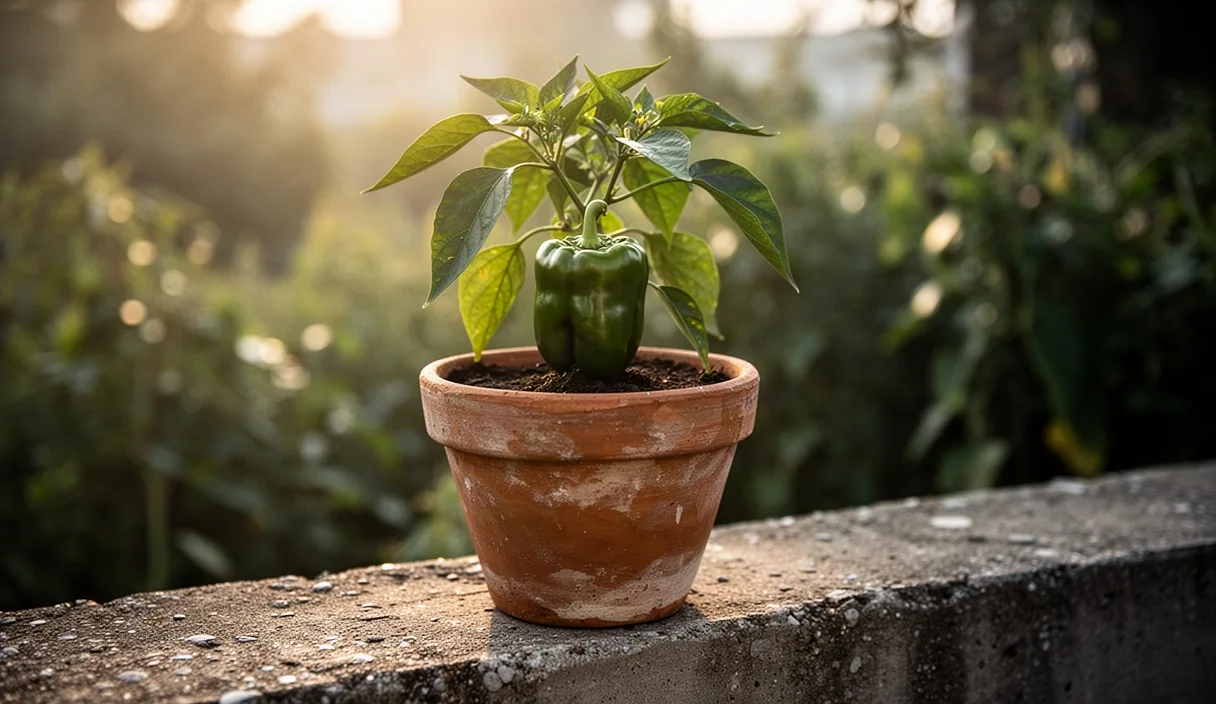
- Check soil moisture deep in the pot with a wooden stick before adding more water to curling plants.
- Notice whether yellowing starts on older bottom foliage or young expanding tips to identify nutrient issues.
- Shield potted plants from dry balcony winds that pull moisture from leaves faster than roots can pump.
When we grow peppers on a balcony, we work within narrow physical margins. A potted plant lacks the deep, cool reservoir of open ground. Its root system occupies an isolated cylinder of compost, bark, and perlite, bounded by thin plastic or porous terracotta. Up on an exposed rail or concrete slab, sunlight hits both the foliage and the container walls, while air currents constantly strip away moisture. Under these pressures, sweet bell peppers, habaneros, and chiltepins speak to us through their leaves. Distortions, cupping, and pale hues are not random failures; they are precise mechanical reactions to environmental loads.
Walking out to inspect the pots each morning gives us direct contact with these shifts. A leaf that curls upward into a trough tells a different story than one whose margins roll down like an umbrella. Yellowing that spreads evenly across an old basal leaf does not share the same origin as bright chlorosis webbing between the veins of soft new shoots. By taking time to feel the turgor of the stems, inspect the undersides of the foliage, and weigh the containers by hand, we can identify what our plants need before cellular damage becomes irreversible.
Reading Physical Symptoms on Potted Foliage
To diagnose an ailing pepper plant, we start by running a finger across both surfaces of the affected foliage. A healthy pepper leaf feels firm, supple, and faintly cool to the touch. When leaf curl sets in, we must observe the direction of the curvature and the rigidity of the tissue. Inward upward curling, where the leaf forms a canoe or trough, is commonly an evaporative defense mechanism. The plant reduces the surface area exposed to direct solar radiation and wind, closing its stomata to conserve its internal sap.
Downward curling, sometimes called clawing, often indicates either an excess of nitrogen or waterlogged root conditions. When nitrogen levels are excessively high, leaf cells along the central rib expand at a different rate than the margins, forcing the leaf into a stiff, downward curve. The tissue usually turns a deep, almost bluish green and feels unusually brittle. If you gently bend a clawed leaf and it snaps with an audible crack, over-fertilization or chronic root hypoxia is almost certainly occurring in the container base.
Color changes require the same close observation. We look at where the yellowing begins. Peppers distribute mobile elements, such as nitrogen and magnesium, from older tissue to fuel tender new growth at the canopy tips. Immobile elements, such as iron and calcium, cannot be moved once deposited. Therefore, yellowing that appears first on the lowest mature leaves points toward mobile nutrient extraction or root suffocation, while yellowing on the newest canopy growth points toward immobile nutrient lockouts or transpiration stalls.
The Lift Test: Gauging Soil Moisture by Pot Weight
Moisture meters with metal probes often mislead us in container gardening. Loose, chunky potting media containing pine bark or pumice can leave dry air pockets around a probe tip, yielding erratic electrical readings. Instead, we rely on the physical heft of the vessel. Learning the dry weight and saturated weight of your containers is the most reliable skill you can develop on a balcony garden.
To calibrate your hands, water a 12-liter or 20-liter container thoroughly until water flows freely from the drainage holes. Allow it to drain for 30 minutes until dripping ceases. Stand over the pot, grasp the rim or handles, and lift it two inches off the deck. Note the heavy, grounded inertia of the saturated media. In contrast, take an identical dry pot filled with unplanted potting soil from your storage bin and lift it. That light, hollow feel represents the point of severe drought stress.
We check our pots daily using this physical motion:
- Saturated ballast: The container feels anchored. Lifting it requires engagement from your legs and back. The topsoil is dark, cool, and damp to the touch. Do not add water.
- Optimal moisture: The pot yields to a one-handed tilt or a brief two-handed lift with moderate resistance. The top two centimeters of mix feel dry and crumbly, but coolness lingers below the surface.
- Depleted lightweight: The vessel tips upward with minimal effort, feeling surprisingly airy. The root ball may have shrunk, creating a visible gap between the soil perimeter and the pot wall. Immediate bottom-soaking or slow, targeted watering is required.
Differentiating Water Stress from Mineral Deficiencies
Water stress and nutritional starvation produce overlapping visual signs on balcony peppers. A plant suffering from root rot caused by stagnant water will turn yellow, mimicking a severe nitrogen deficiency. This happens because drowned roots lose their root hairs and can no longer draw nitrate ions into the vascular stream. Before adjusting fertilizer regimes, we must distinguish between fluid transport failures and chemical deficiencies.
| Symptom Profile | Location on Plant | Texture of Leaf | Probable Cause |
|---|---|---|---|
| Uniform pale yellow, older leaves shed first | Basal, lowest branches | Soft, thinning, limp | Nitrogen deficiency or chronic overwatering |
| Interveinal chlorosis, veins stay bright green | Mid-tier mature leaves | Crisp, standard thickness | Magnesium deficiency |
| Interveinal chlorosis, turning ivory or white | New terminal shoots | Tender, easily bruised | Iron lockout (often high pH or cold roots) |
| Cupped margins, crinkled edges, blunt tips | Emerging leaves and buds | Thick, distorted, brittle | Calcium deficiency (transpiration stall) |
| Upward rolled margins, dull grayish hue | Upper canopy facing open sky | Parchment-like, warm | Evaporative shock / extreme heat |
Notice the specific behavior of calcium deficiency. Gardeners often assume calcium is absent from the soil mix when they see distorted, cupped tips or blossom end rot on green fruit. In container culture, calcium is almost always present in the compost or tap water. However, calcium moves through the plant strictly via the transpiration stream, carried along as water evaporates from the foliage. If wind speeds are too fierce or the air is stagnant and humid, transpirational flow stops, and calcium fails to reach the growing tips, causing classic edge-curling and puckering.
Managing High Balcony Wind and Evaporative Shock
Balconies act as wind tunnels. Air striking a multi-story building facade compresses and accelerates across exterior balustrades and floor plates. A pepper plant adapted to garden beds can thrive in gentle breezes, but continuous urban drafts rip moisture from broad leaf surfaces faster than small root volumes can replenish it. When this occurs, the leaves curl upwards into tight cylinders to shield their breathing pores.
We modify this microclimate by breaking the wind before it strikes the foliage. Solid barriers like glass or acrylic sheets create harsh turbulence behind them, dumping swirling downdrafts directly onto your plants. We prefer permeable screens, such as woven reed fencing, 40 percent agricultural shade cloth, or simple slatted timber screens lashed to the balcony railings. These materials absorb the kinetic energy of the wind and allow a softened, filtered draft to pass through at roughly a third of the external velocity.
Positioning also dictates survival. We group our pots together into dense clusters rather than spacing them out in isolated rows. Clustering creates a shared microclimate where transpirational moisture from one pot softens the harsh, dry air surrounding its neighbor. Place sturdier, woody plants like rosemary or dwarf citrus along the windy perimeter, sheltering the tender foliage of your habaneros and sweet peppers behind them in the interior pocket.
Adjusting Liquid Feeds for Small Root Volumes
Container mixes are largely inert sponges designed for air retention and drainage. Because daily watering leaches dissolved mineral salts out of the drainage base, potted peppers rely on consistent replenishment. Yet applying standard field doses of concentrated mineral fertilizers to a 15-liter pot under high balcony heat often leads to fertilizer burn, root dehydration, and dramatic leaf clawing.
When synthetic or concentrated organic feeds dry out within a small root zone, the salt concentration in the remaining moisture spikes rapidly. This draws water backward out of the root cells through reverse osmosis, causing leaf edges to brown and curl downward. We avoid sudden shocks by following a weak, frequent nutritional regime rather than heavy intermittent feedings.
If a liquid seaweed or tomato feed suggests 10 milliliters per liter of water once every two weeks, we mix 3 to 4 milliliters per liter and apply it every fourth watering. This maintains a steady, low-salinity environment around the root hairs. Always apply fertilizer to media that is already slightly damp; never pour liquid nutrients into a bone-dry pot, as the desiccated root tissue will absorb the concentrated salts too quickly and suffer chemical scorching.
A Simple Recovery Protocol for Stressed Plants
When a pepper plant shows simultaneous yellowing and severe leaf curl, resist the temptation to apply multiple remedies at once. Layering fertilizer, pesticides, and heavy soakings simultaneously will overwhelm the stressed vascular system. We follow an orderly recovery sequence to bring the plant back into balance.
- Isolate and shelter: Lift the container and move it off exposed railings. Set it on the balcony floor against an interior wall where it receives bright, indirect light rather than scorching midday sun, protected from direct wind drafts.
- Assess root hydration: Perform the lift test. If the pot is waterlogged and heavy, clear the saucer underneath immediately. Elevate the container on small wood blocks or pot feet so air circulates beneath the drainage holes. Do not water until the container returns to its moderate-weight threshold.
- Flush if salts have accumulated: If the pot feels light, but the leaves are stiffly clawed and leaf margins show brown, salty margins, slowly pour clean, unchlorinated water through the pot, equivalent to three times the container volume. Let it drain completely to dissolve accumulated fertilizer residues.
- Prune necrotic tissue only: Do not strip yellowing leaves that remain supple. The plant is reabsorbing nutrients from those tissues to preserve its central growing tip. Only clip off leaves that are brown, dry, and crispy to reduce potential points for fungal entry.
- Resume feeding gradually: Keep the plant in its sheltered position for 7 to 10 days. Once you observe fresh, bright green growth emerging from the branch nodes without curl or distortion, return the plant gradually to its original sunny position over a period of four days.
Common Mistakes
One frequent error is misting balcony foliage during hot, dry afternoons to counteract leaf curl. Water droplets on upper leaf surfaces evaporate within minutes in balcony winds and do not increase ambient humidity in any meaningful way. Worse, if cold water hits hot foliage under strong sun, it shocks the vascular cells and can exacerbate cellular distortion.
Another regular misstep is placing containers inside deep, glazed decorative cachepots that lack drainage. Standing water collects invisibly in the base, drowning the root tips while the top layer of media appears deceptively dry. Always ensure the internal nursery container can drain freely, and dump collection saucers 20 minutes after watering.
Finally, avoid reaching for broad-spectrum insecticide sprays the moment you spot cupped leaves. While microscopic pests like broad mites and aphids cause leaf curl by feeding on sap, chemical sprays applied during warm, windy balcony days will scorch damaged foliage. Examine the undersides of the distorted leaves with a 10x jeweler loupe first; if no crawling pests or webs are present, the issue is physical, not biological.
Moving Forward with Your Balcony Peppers
Managing potted peppers requires observing the subtle changes of living materials held in small spaces. Your immediate next action should be physical: walk out to your balcony and lift each pepper pot to register its current ballast. Run your thumb and forefinger across the curved leaves to confirm whether the tissue feels limp and depleted or stiff and overloaded with salts.
If your balcony sits high and experiences regular winds, secure a simple stretch of wind-filtering fabric along the balustrade this weekend. Group your pots to shield their containers from baking sun and reduce root temperature swings. Potted peppers possess remarkable resilience; when we provide steady moisture, softened airflow, and mild, consistent feeding, their root systems quickly steady themselves, and the canopy will spread clean, flat leaves ready to bear fruit.
Our field notes serve general horticultural education; consult your local agricultural extension service for regional biosecurity rules and persistent plant pathology. Disclaimer

Complementary Reading
-
 Container & Balcony Crops 9 min read
Setting Up Balcony Grow Lights for Stout Winter Greens
You will master lighting clearance distances, daily photoperiod timing, and cool-air ventilation on indoor growing racks. Your winter salads and brassica leaves will stay dense and low rather than stretching into pale threads.
-
 Container & Balcony Crops 10 min read
Sowing Winter Radishes and Asian Greens for Autumn Bites
You will learn how to schedule mid-August sowings into empty containers as the harsh summer sun relents. Quick-maturing daikon radishes and hardy pak choi flourish in cooling weather, yielding crisp leaves until hard frosts.